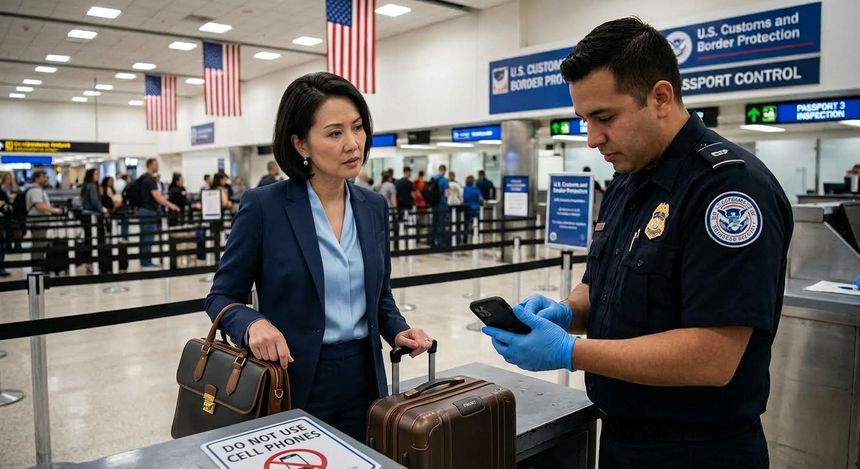

- In United States v. Alisigwe, a split Second Circuit panel held that officers need no individualized suspicion—not even reasonable suspicion—to search international travelers’ cellphones when they enter or exit the country. In doing so, the Second Circuit appears to have aligned with the approach the Eleventh Circuit took in United States v. Touset.
- The concurrence disagreed with that conclusion and would have affirmed the judgment only because there was reasonable suspicion to search the defendant’s cellphone.
- The decision puts to bed—for now, at least—an issue that had been percolating within the Second Circuit and on which the Courts of Appeals have taken a variety of approaches. In doing so, Alisigwe may set the stage for the Supreme Court to provide guidance regarding the scope of electronic device searches at the border.
Background
United States v. Alisigwe. In 2019, Chinwendu Alisigwe, was returning to the United States from a trip to Nigeria when officers stopped him at JFK and pulled him into secondary immigration screening. On at least one occasion, the officers instructed Alisigwe to unlock his cellphone, and after Alisigwe complied, they scrolled through the phone and photographed its contents. The same thing happened again in 2021. Together, the searches yielded images of other people’s names, birthdates, and Social Security numbers, as well as WhatsApp message discussing a particular stolen identity.
A grand jury later indicted Alisigwe on identity theft and other fraud charges, and Alisigwe moved to suppress the evidence obtained during the border stops. The district court declined to suppress, holding that, although officers needed reasonable suspicion to conduct the searches, they had cleared that threshold in this case. Alisigwe then proceeded to trial, was convicted on multiple counts, and was sentenced to five years of imprisonment.
Border Searches More Broadly. Although the Fourth Amendment generally requires a warrant supported by probable cause before the government lawfully can conduct a search or seizure, there are several exceptions to that requirement. Relevant here is the so-called border-search exception, which permits law enforcement to conduct certain searches (1) without a warrant and (2) without a showing of probable cause. For example, the Supreme Court has held that the border-search exception permits agents to disassemble an entire car to find hidden drugs. The Supreme Court also has explained that “routine” border searches require no individualized suspicion, while “nonroutine” border searches—like detaining a person for 16 hours until she passed a container of drugs she had swallowed—require reasonable suspicion.
The proliferation of cellphones and other handheld electronic devices capable of storing massive amounts of information has generated controversy in the application of the border-search exception. Over the past 15 years, courts have grappled with how to balance travelers’ privacy interests with the government’s interests in securing the border, preventing the flow of contraband, and other factors that animate the border-search exception. The Ninth Circuit, for example, has held that a manual search of a phone is “routine,” and thus permissible with no showing of suspicion, but that a forensic search is “nonroutine” and requires reasonable suspicion. The Eleventh Circuit, by contrast, has held that agents need no individualized suspicion at all to conduct even the most invasive forensic search of an electronic device.
This issue has been no less controversial in the district courts within the Second Circuit. In 2023, the Honorable Jed S. Rakoff, United States District Judge for the Southern District of New York, held that, notwithstanding the border-search exception, in the absence of exigent circumstances, the government must obtain a warrant to search a cellphone. Earlier this summer, however, in the prosecution of Huawei Technologies, the Honorable Ann M. Donnelly disagreed with Judge Rakoff’s opinion and sided with those judges in the Eastern and Southern Districts of New York who have held that certain cellphone searches are subject to the lower threshold of reasonable suspicion.
Holding
The key issue that Alisigwe presented was whether agents needed to obtain a warrant in order to search his phone. Every member of the panel rejected that argument: the majority held that no individualized suspicion was required, and the concurrence held that merely reasonable suspicion was sufficient in this case.
Majority Opinion. The majority reached its conclusion based on precedent holding that “no suspicion is required before the government searches a traveler’s property at the border,” because “[s]earches of property are made reasonable by that person’s decision to enter this country.” (Unless otherwise indicated, this post omits internal quotation marks, citations, and other alterations.) The majority specifically rejected Alisigwe’s argument that cellphones are different and should be subject to a different rule. Distinguishing Riley v. California, 573 U.S. 373 (2014)—in which the Supreme Court held that officers may not conduct warrantless cellphone searches incident to arrest—the majority determined the border-search exception and the search-incident-to-arrest exception that was at issue in Riley were apples and oranges.
The majority did not stop there. It concluded that the upshot of Supreme Court and Second Circuit precedent is that “the label ‘non-routine,’” which generally gives rise to a requirement of reasonable suspicion “should generally be reserved for intrusive border searches of the person (such as body-cavity searches or strip searches), not belongings. Only more invasive searches, like strip searches, are nonroutine and require reasonable suspicion.” Moreover, “the reasons that might support a requirement of some level of suspicion … do not apply even to the most extensive searches of property.”
Concurrence. The Honorable Eunice C. Lee, United States Circuit Judge for the Second Circuit Court of Appeals, concurred in the judgment only. She agreed that a cellphone search at the border requires neither a warrant nor probable cause. She would have held instead that (1) “cellphone searches are not routine,” and, as a result, (2) such “non-routine searches may require reasonable suspicion.” And because no one disputed that there was reasonable suspicion in Alisigwe, Judge Lee would have affirmed on that basis.
Judge Lee also responded to the majority’s insinuation that property searches are per se routine and that only searches of the person can be considered nonroutine. Specifically, she pointed to Second Circuit precedent that “acknowledg[ed] the possibility that a search of an electronic data storage device such as a computer disk might be non-routine,” thereby “implicitly reject[ing] the notion that it is only strip searches that are non-routine.”
Key Takeaways
Cellphones, tablets, laptops, and other electronic devices are now fair game at JFK and other border crossings within the Second Circuit. International travelers flying into or out of JFK should assume that agents may demand access to their electronic devices and that evidence obtained from them may be admissible against them. That reaches everyone: executives, lawyers, and employees returning from overseas travel with privileged communications, client data, or trade secrets on their devices.
What Alisigwe does not address: Must you give your password? The decision briefly mentions that agents “instructed” Alisigwe to disclose his password during one of the searches and that Alisigwe did so. But just as courts have split on the level of suspicion required for a border search, so too have they split on the circumstances where agents may compel a traveler to unlock an electronic device. Some courts have held that the Fifth Amendment protects travelers from disclosing the passwords to their devices. Others—including Judge Rakoff, who perceived extensive Fourth Amendment protections in the context of cellphone searches—have held that the Fifth Amendment has almost no application to a cellphone password.
What Alisigwe (purportedly) did not decide: What about a forensic search? Alisigwe dealt with a so-called “manual” search—agents scrolled through the phones manually at the airport and recorded evidence. Other cases have raised the question of “forensic” searches, where agents use software to copy the entire contents of the device, including portions that would not be accessible to an ordinary user. Although the Alisigwe majority claimed it was not addressing forensic searches, it seems clear that this panel would have reached the same conclusion. If, as the majority suggested, property searches are per se routine, and routine searches require no showing of suspicion, then it would follow that even forensic searches do not require individualized suspicion. That is the rule in the Eleventh Circuit, and what Judge Lee specifically criticized in her concurrence: “Under the majority’s view, law enforcement at an international airport, whether it is TSA, Customs and Border Protection, or ICE, has unlimited power to review the data on any traveler’s cellphone. This unrestricted authority to search is not a carefully-crafted exception to the Fourth Amendment to address an immigration or contraband-related interest in controlling who or what comes into the country; it eliminates Fourth Amendment protections in this context.”
It seems all but certain that the Supreme Court will weigh in on this question soon. With Alisigwe, there are now at least seven published Court of Appeals decisions analyzing the border-search exception in the context of electronic devices. There is a split between, at a minimum, the Eleventh and Ninth Circuits. It seems only a matter of time until the Supreme Court resolves the question once-and-for-all.
You can sign up to receive White Collar Appeal email updates by clicking here.
/Passle/67ead9999050990b49b427a6/SearchServiceImages/2026-09-15-14-22-32-713-6aa954a8e451314850d206ec.jpg)
/Passle/67ead9999050990b49b427a6/SearchServiceImages/2026-09-08-12-42-23-438-6aa002af5357362d682e3eac.jpg)
/Passle/67ead9999050990b49b427a6/SearchServiceImages/2026-09-02-21-16-43-932-6a98923b1f4ad09057fea213.jpg)