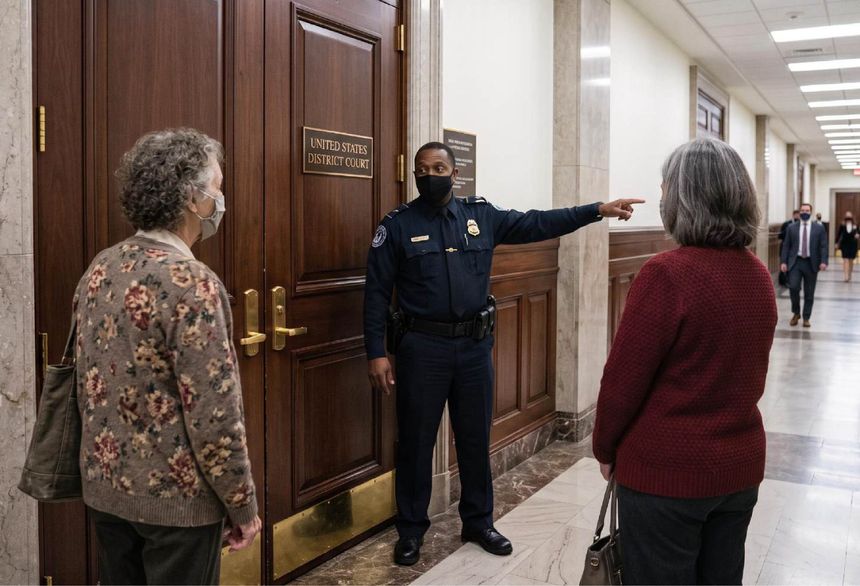


In United States v. Girard, the Third Circuit held that permitting spectators to observe the opening day of trial only by audiovisual feed—and later excluding the defendants’ mothers from the courtroom—violated the defendants’ Sixth Amendment right to a public trial.
But the Third Circuit affirmed the convictions notwithstanding these violations, because they did not constitute plain error. Specifically, the Sixth Amendment violations did not seriously affect the fairness, integrity, or public reputation of the proceedings.
Girard refines the framework for public-trial claims, distinguishing a full courtroom closure from the narrower exclusion of particular spectators. It is also a striking example of the consequences that can flow from trial counsel’s failure to articulate clearly the grounds for an objection and to continue lodging the objection each time the violation recurs.
Background
Two defendants proceeded to trial on racketeering charges in March 2022. The trial began the day after the district had relaxed its pandemic-related precautions to permit certain in-person proceedings. Despite the court’s reopening, however, as the parties prepared for opening statements, the district court announced that spectators could not sit in the gallery and instead would have to observe the trial from a different courtroom in which an audiovisual feed would display the proceedings. The district court would not even permit the defendants’ families in the courtroom for openings, despite defense counsel’s argument that excluding them would not “comply with the Constitution.” Later, as testimony got underway, the district court reversed course and announced that it would permit some spectators in the courtroom the next day.
A series of courtroom access problems followed. A few days later, defense counsel notified the district court that the overflow room had remained closed until 10:00 a.m., well after that day’s proceedings had begun. The district court called the closure an “inadvertent error” and noted that seats in the courtroom had been available. A few days after that, defense counsel notified the court that a Marshal had instructed one defendant’s mother that she could observe only from the overflow room, even though there were seats available in the courtroom. The court said it would “deal with that.” No one raised the issue again during the final four days of trial.
The jury convicted, and the defendants moved for a new trial on Sixth Amendment public-trial grounds. At an evidentiary hearing, the only witness the district court credited was one of the defendants’ mothers, who testified that for all but the last few days the Marshals directed her and the other defendant’s mother to the overflow room without explanation. The district court denied the new-trial motions, finding that (1) social distancing requirements resulted in fewer seats in the courtroom gallery, (2) seats had been available on a first-come, first-served basis, and (3) in totality, “the public was not excluded from the trial.”
Holdings
The Third Circuit held that the limitations on courtroom access violated the Sixth Amendment but did not require vacatur of the convictions. It all came down to the standard of review.
Standard of review. Here, the court held that neither defendant adequately presented the Public Trial Clause issue to the district court during trial. Even though one defendant’s counsel argued that excluding families during opening statements would not “comply with the Constitution,” the Third Circuit held that was “too vague to adequately apprise the District Court of how its action violated the Public Trial Clause.” Nor did defense counsel frame the midtrial notifications to the district court about access problems as public-trial objections. The Third Circuit thus concluded that the defendants had not preserved the errors for de novo review.
As a result, the court applied plain-error review, under which it will vacate only if (1) there was an error; (2) it was “plain”; (3) it affected “substantial rights”; and (4) it “seriously” affected “the fairness, integrity or public reputation of judicial proceedings.” (This post omits citations, quotation marks, and other alterations from quotations.)
Violations of the Public Trial Clause. The court held that the presumption of an open courtroom gives way only when an “overriding interest” justifies closure. Even then, before fully closing the courtroom, the trial judge must (1) find that the closure is no broader than necessary to protect the overriding interest, (2) consider reasonable alternatives (whether or not the parties suggest them), and (3) make findings adequate to support the closure.
Applying those principles, the Third Circuit found two errors. First, the district court erred on the first day of trial when it failed to address alternatives to relegating spectators to an overflow room. Notwithstanding the audiovisual feed, the Third Circuit held that the courtroom “ceased to be open” on the first day of trial, and the Sixth Amendment required the district court to provide a justification. The second violation was the Marshals’ refusal to admit the defendants’ mothers to the courtroom. The mothers’ “physical presence would have kept their sons’ triers keenly alive. Indeed, they were especially likely to watch closely and consistently given their special concern with the trial. Nothing in the record supported the exclusion, and the district judge’s lack of awareness did not cure the deprivation.
Substantial effect on fairness, integrity, or public reputation. But the court declined to vacate because the trial nevertheless “possessed the publicity, neutrality, and professionalism that are essential components of upholding an accused’s right to a fair and public trial.” According to the court, even though it would have been “preferable” to permit spectators in the courtroom from day one, “nobody involved in the trial reasonably could have thought that any of their actions would escape contemporaneous review in the forum of public opinion.” Nor did the closures undermine confidence in the district court’s impartiality, because it was a good-faith effort to protect against COVID-19, not a way to keep the proceedings secret. And there was no accusation of misconduct by the prosecutor, judge, or another party that raised doubt about professionalism. By contrast, retrying a three-week racketeering case that had concluded more than four years earlier, involving nearly 50 witnesses, would impose significant costs and hand the defendants a “windfall” contrary to the interests of justice.
Key Takeaways
Public-trial objections must be specific and contemporaneous to avoid plain-error review. The decisive move in Girard was procedural. Invoking “the Constitution” did not preserve a challenge under the Public Trial Clause, and silence over the final four days of trial meant the Marshals’ exclusion of the mothers was not preserved either. To avoid plain-error review, counsel who perceive a closure or exclusion problem should object on the record, identify the specific constitutional defect, and renew the objection each time the problem recurs.
The fourth prong of plain-error review can be brutal. A violation of the Public Trial Clause typically constitutes structural error, meaning that it affects the entire framework of a criminal trial and automatically requires vacatur—where a defendant has preserved the issue. Girard is a stark reminder of the stakes facing trial counsel. No one wants to beat a dead horse by continually raising objections that have been overruled. Likewise belaboring an objection by stating the seemingly obvious provision on which constitutional objection is based. Girard sends a clear message that trial counsel may have to be persistent (and pedantic) to avoid losing otherwise meritorious appeals.
Girard distinguishes full closures from spectator-specific exclusions. The Third Circuit distinguished between the more common situation where a trial judge finds reason to exclude particular spectators rather than close the entire courtroom. Like every Court of Appeals to confront this issue (all but the D.C. and Seventh Circuits), the Third Circuit held that those narrower exclusions need only be supported by a “substantial reason,” not an “overriding” one. Yet even then, the district court still must consider reasonable alternatives, determine that the exclusion is necessary, and make findings sufficient to support the exclusion.
You can sign up to receive White Collar Appeal email updates by clicking here.
/Passle/67ead9999050990b49b427a6/SearchServiceImages/2026-09-15-14-22-32-713-6aa954a8e451314850d206ec.jpg)
/Passle/67ead9999050990b49b427a6/SearchServiceImages/2026-09-08-12-42-23-438-6aa002af5357362d682e3eac.jpg)
/Passle/67ead9999050990b49b427a6/SearchServiceImages/2026-09-02-21-16-43-932-6a98923b1f4ad09057fea213.jpg)