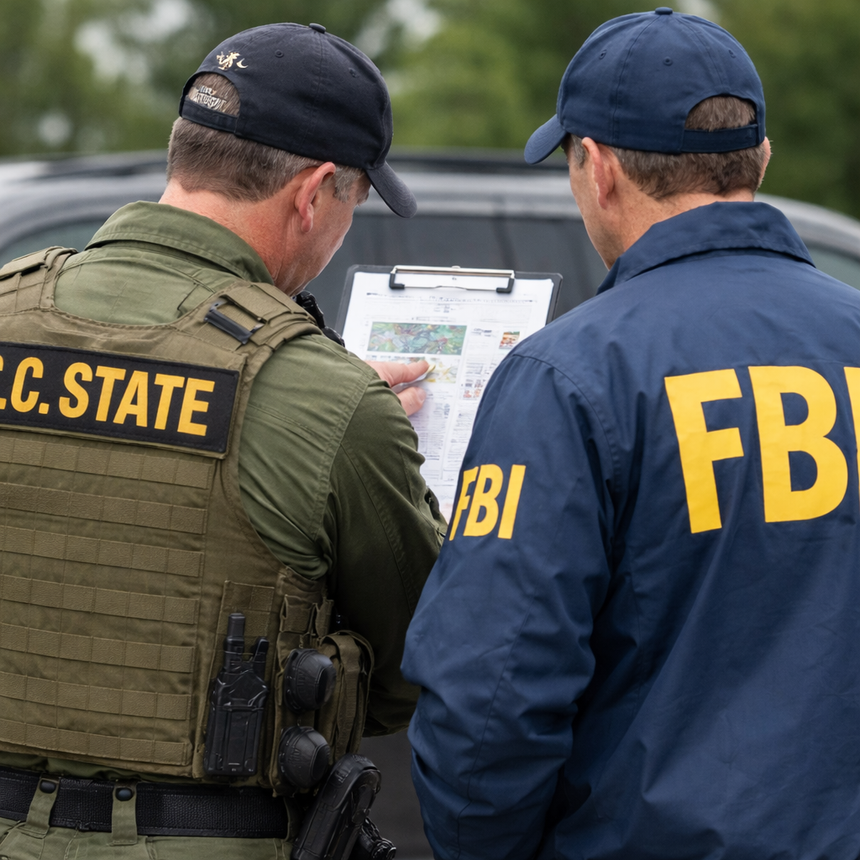


- In United States v. Ritter, the Fourth Circuit confronted whether a defendant’s lie to state investigators had the requisite federal nexus to sustain a conviction for witness tampering under federal law.
- The Fourth Circuit affirmed a conviction on the basis that it was “reasonably likely” that the defendant’s lie to state officials would be communicated to federal officials.
- Ritter thus suggests that witness tampering under Section 1512(b) is more expansive than other obstruction-of-justice statutes.
Background
Daqua Ritter had an on-again, off-again relationship with a transgender woman that he wanted to keep secret. He grew increasingly angry and violent when people in their rural South Carolina community discussed the relationship. One day, Ritter and the woman were pulled over for speeding in South Carolina. Hours later, the woman was found dead in a car on the side of the road.
Suspicion quickly turned to Ritter, and South Carolina Law Enforcement Division agents interviewed him the day the woman’s body was discovered. Ritter lied in the interview, including by claiming that he hadn’t been with the woman the day she was murdered.
A federal grand jury indicted Ritter for a hate-crime murder, using a gun during a crime of violence, and witness tampering under 18 U.S.C. § 1512(b)(3). The witness-tampering charge derived from the lies he told to the state investigators during the interview.
The trial judge instructed the jury that, to prove witness tampering under Section 1512(b)(3), the government had to establish three elements: (1) Ritter knowingly engaged in misleading conduct toward another person; (2) he acted with the intent to hinder, delay, or prevent communication of information to a federal law enforcement officer; and (3) the information related to the commission or possible commission of a federal offense.
Ritter was convicted at trial on all counts. As relevant here, Ritter argued on appeal that his lies to state investigators could not support a federal witness-tampering charge, because there was no evidence that he intended “to hinder, delay, or prevent communication of information to a federal law enforcement officer.”
Holding
The Fourth Circuit affirmed the witness-tampering conviction, relying on Fowler v. United States, 563 U.S. 668 (2022). In Fowler, the Supreme Court addressed Section 1512(a)(1)(C), which criminalizes killing a witness “with the intent to … prevent the communication by any person to a law enforcement officer … of the United States of information relating to the commission or possible commission of a Federal offense.” (emphasis added). The Supreme Court held that a defendant acts with the requisite intent to “prevent” a communication whenever it is reasonably likely that the information would have been communicated to a federal officer but for the defendant’s conduct. The Court further explained that there is both a subjective and objective aspect to this test: (1) the defendant must subjectively “inten[d] to prevent communications to law enforcement officers in general” and (2) it must objectively be reasonably likely that “at least one relevant communication would have been made to a federal law enforcement officer” but for the defendant’s conduct.
Witness tampering under Section 1512(b)(3) criminalizes “engag[ing] in misleading conduct toward another person, with intent to … hinder, delay, or preventthe communication to a law enforcement officer … of the United States of information relating to the commission or possible commission of a Federal offense.” (emphasis added).
The Ritter Court applied Fowler’s reasonable-likelihood standard to Section 1512(b)(3) on the basis that the statutory language was sufficiently similar to Section 1512(a)(1)(C).
Analyzing the facts of Ritter against this standard, the Fourth Circuit affirmed the conviction. It reached this conclusion because (1) Ritter’s conduct constituted a federal crime; (2) there was testimony that South Carolina agents “share information all the time” with federal officers; and (3) the investigation eventually did involve federal law enforcement.
Key Takeaway
Section 1512(b) appears to be more expansive than Sections 1503 and 1512(c)(2). Obstruction of justice under Section 1512(c)(2) criminalizes “corruptly … obstruct[ing], influenc[ing], or imped[ing] any official proceeding, or attempt[ing] to do so.” Critically, however, a conviction under this statute requires a showing of a nexus between the defendant’s actions and the official proceeding (defined to include a federal grand jury investigation) that the defendant is charged with obstructing. In United States v. Aguilar, 515 U.S. 593 (1995), the Supreme Court held that the defendant’s act “must have a relationship in time, causation, or logic with the judicial proceedings…. In other words, the endeavor must have the ‘natural and probable effect’ of interfering with the due administration of justice.” Thus, “if the defendant lacks knowledge that his actions are likely to affect the judicial proceeding, he lacks the requisite intent to obstruct.” (Aguilar addressed Section 1503, but numerous courts have applied its reasoning to Section 1512(c)(2), as well.)
In Aguilar, the defendant (a federal district court judge) lied to FBI agents about his participation in an embezzlement case and his knowledge of a wiretap authorized by another district court judge. At the time that the defendant lied to the agents, he was aware that a grand jury was investigating an alleged conspiracy to influence the embezzlement case. There was no indication, however, that the grand jury had “authorized or directed the FBI investigation,” nor that the grand jury had even summoned the particular agents to testify. Therefore, the Court held that it was “speculative” as to what use would be made of the defendant’s false statements and that it could not be said that the “natural and probable effect” would be the interference with the due administration of justice.
United States v. McDonnell involved a state-federal interplay similar to Ritter. In that case, which involved a corruption prosecution of the former Governor and First Lady of Virginia, the former First Lady was convicted of obstruction under Section 1512(c)(2) for providing a misleading note to a witness at a time when there was a state, but not a federal, grand jury investigation. The district court granted a judgment of acquittal because Mrs. McDonnell’s conduct was too attenuated from any impact on a federal grand jury proceeding. (One of the authors of this post was trial and appellate counsel to Mrs. McDonnell.)
Aguilar and McDonnell thus seem to set a much higher barrier to prosecuting the conduct at issue in Ritter under Sections 1503 and 1512(c)(2). Ritter lied to state investigators, and the Fourth Circuit held that was sufficient under Section 1512(b)(3) because state “agents ‘share information all the time’ with federal officers.” By contrast, a lie to a federal law enforcement agent was not enough in Aguilar under Section 1503, and a misleading statement to a witness in a state grand jury investigation was not enough in McDonnell under Section 1512(c)(2).
Of course, Section 1512(b)(3) requires only that the communication be to a federal “law enforcement official,” whereas Section 1512(c)(2) applies to “official proceedings” and Section 1503 to grand or petit jury proceedings. But there is little reason to think that the former should require a lower threshold for prosecution than the latter. In Aguilar, the Court explained that “what use will be made of false testimony given to an investigating agent who has not been subpoenaed or otherwise directed to appear before the grand jury is far more speculative. We think it cannot be said to have the ‘natural and probable effect’ of interfering with the due administration of justice.” It is difficult to discern why a different rule should apply in the context of Section 1512(b)(3). Nor does Ritter (or Fowler, for that matter) address Aguilar at all.
Defendants facing prosecution under Section 1512(b)(3) thus should argue for a nexus requirement similar to Aguilar. Although Ritter may foreclose that argument within the Fourth Circuit, the argument main gain traction in other circuits or lay the groundwork for a potential cert petition.
You can sign up to receive White Collar Appeal email updates by clicking here.
/Passle/67ead9999050990b49b427a6/SearchServiceImages/2026-09-08-12-42-23-438-6aa002af5357362d682e3eac.jpg)
/Passle/67ead9999050990b49b427a6/SearchServiceImages/2026-09-02-21-16-43-932-6a98923b1f4ad09057fea213.jpg)
/Passle/67ead9999050990b49b427a6/SearchServiceImages/2026-08-21-17-26-22-381-6a888a3efb7086a3130ab44b.jpg)